(619) 839-0636


According to the California Office of Traffic Safety, alcohol-impaired driving continues to be one of the leading causes of deadly and serious injury crashes on state roads. This means that if you’re charged with drinking and driving in Carlsbad, you can expect the police and prosecutors to pursue charges aggressively, even when the evidence is questionable. This is why you should contact a Carlsbad DUI lawyer right away.
I’m Attorney David Rubin, and I’ve spent years defending those facing DUI charges. As a former prosecutor turned criminal lawyer, I know how the other side is likely to prepare their case against you, and use that insight to fight for you. I’ll examine every aspect of your arrest, from the traffic stop to the investigation, chemical testing, and evidence collection, looking for errors or inconsistencies. At all times, my goal is to challenge the allegations and get your charges reduced or dismissed when possible.
Why Hire Rubin Law Office for Your DUI Case?
If you’ve been charged with DUI, you need an experienced DUI defense attorney who knows how to challenge the allegations and make the prosecution prove its case. At my firm, Rubin Law Office, P.C., I bring the following advantages to the table:
- Prosecutorial Experience: I spent a decade as a prosecutor in Massachusetts, including time as an Assistant District Attorney at the Middlesex District Attorney’s Office. Today, I bring that courtroom background to my California defense practice, and I will put it to work for you.
- Thorough Investigation: When you hire me, I scrutinize evidence like police reports, body camera footage, breathalyzer calibration records, field sobriety testing procedures, and witness statements. Procedural errors and evidentiary inconsistencies can change the direction of a case, and I know where to look for them.
- Protection of Your Driving Privileges: A DUI arrest triggers a separate administrative action through the California DMV. I can help you request a hearing, challenge a suspension, and pursue restricted driving privileges so you’re not cut off from getting to work or meeting other obligations while your case is pending.
- Aggressive Negotiation Skills: Not every DUI case goes to trial. I work to negotiate with prosecutors for reduced charges, alternative sentencing, or dismissal whenever possible. Having spent years on the prosecution side, I know what drives their decisions and what arguments have impact at the negotiating table.
- Trial-Ready Advocacy: If your case goes to court, you need an attorney who’s prepared to hold the prosecution to its burden of proof. I prepare every case for litigation so that if a trial becomes necessary, you have an attorney who has been there before and knows how to respond.
DUI charges can follow you for years in the form of a criminal record, higher insurance rates, and professional setbacks. Reaching out to Rubin Law Office early gives you the best shot at a strong defense. I handle criminal cases for a flat fee, so call today for a confidential consultation.
How Does a DUI Work in California?
California law prohibits operating a motor vehicle while impaired by alcohol or drugs. For most drivers, the legal blood alcohol concentration limit is 0.08%, but there are important exceptions:
- Commercial drivers are held to a stricter standard of 0.04%.
- Drivers under 21 are subject to California’s zero-tolerance policy, which sets the limit at 0.01%.
You can be charged with DUI even if your BAC falls below these thresholds. If a law enforcement officer determines that alcohol or drugs have impaired your ability to drive safely, you can still be arrested and charged.
Common Types of DUI Charges
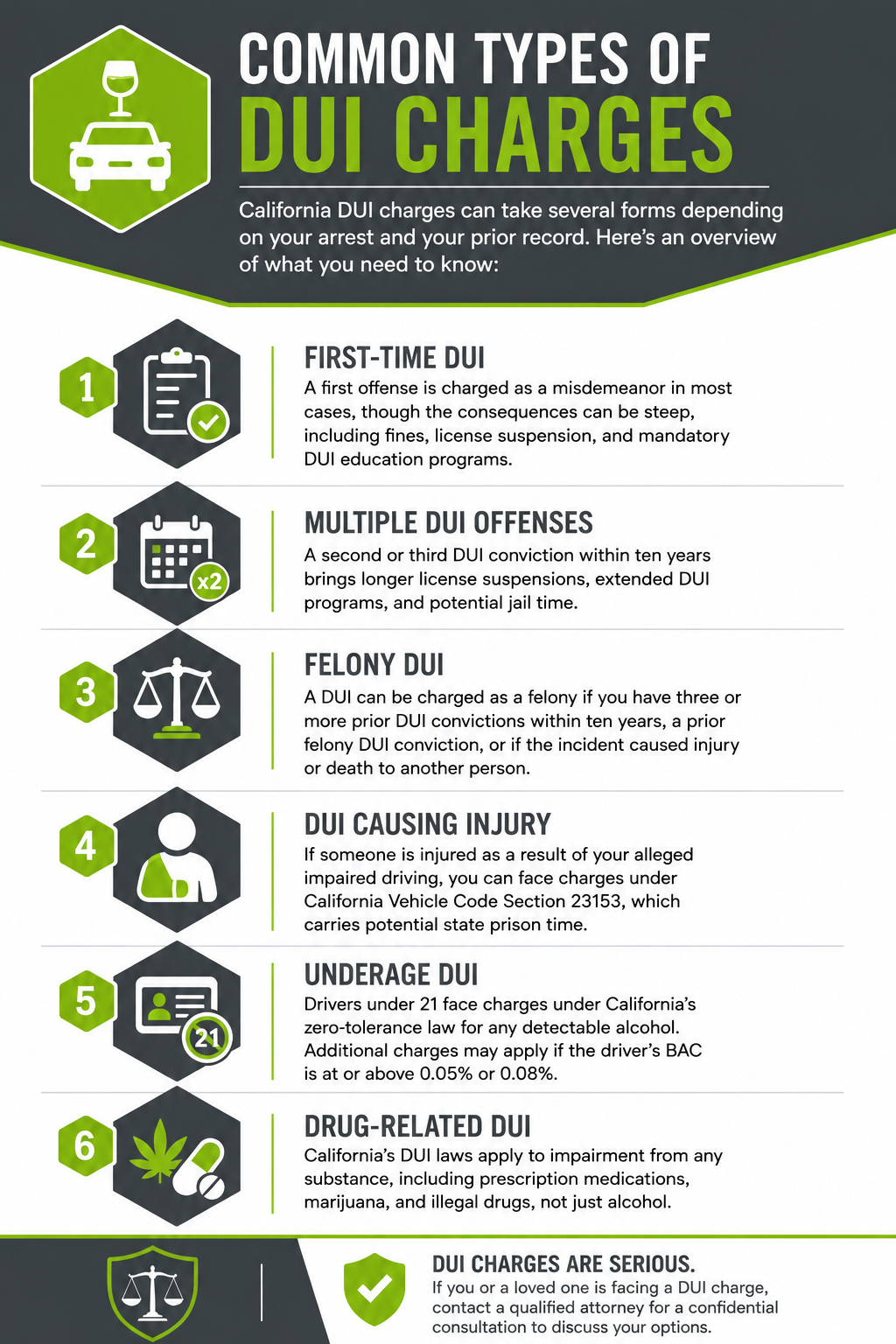
California DUI charges can take several forms depending on your arrest and your prior record. Here’s an overview of what you need to know:
- First-Time DUI: A first offense is charged as a misdemeanor in most cases, though the consequences can be steep, including fines, license suspension, and mandatory DUI education programs.
- Multiple DUI Offenses: A second or third DUI conviction within ten years brings longer license suspensions, extended DUI programs, and potential jail time.
- Felony DUI: A DUI can be charged as a felony if you have three or more prior DUI convictions within ten years, a prior felony DUI conviction, or if the incident caused injury or death to another person.
- DUI Causing Injury: If someone is injured as a result of your alleged impaired driving, you can face charges under California Vehicle Code Section 23153, which carries potential state prison time.
- Underage DUI: Drivers under 21 face charges under California’s zero-tolerance law for any detectable alcohol. Additional charges may apply if the driver’s BAC is at or above 0.05% or 0.08%.
- Drug-Related DUI: California’s DUI laws apply to impairment from any substance, including prescription medications, marijuana, and illegal drugs, not just alcohol.
What Happens When You’re Arrested for DUI in California?
Most DUI arrests begin with a traffic stop for a moving violation, equipment issue, or sobriety checkpoint. Law enforcement must have a lawful basis to pull you over – if they don’t, you may be able to challenge your arrest later on. Here’s a general overview of what happens next:
- Field Sobriety Tests: You may be asked to perform standardized field sobriety tests, including the horizontal gaze nystagmus test, the walk-and-turn, and the one-leg stand. These tests are voluntary in California, though refusal can be noted by the officer.
- Breath or Blood Testing: After an arrest, you’re required under California’s implied consent law to submit to a chemical test. You can choose between a breath or a blood test. Refusing this test after arrest has automatic consequences, including a one-year license suspension for a first refusal.
- Arrest and Booking: If the officer concludes you’re impaired, you’ll be placed under arrest, transported to a law enforcement facility, and booked. Your vehicle may also be impounded.
- DMV Administrative Proceedings: Your DUI arrest triggers a separate administrative action through the DMV. You have a limited window after your arrest to request a hearing to contest your license suspension.
- Court Appearances: Your criminal case proceeds separately from the DMV hearing. You’ll be required to appear for arraignment, pre-trial hearings, and potentially a trial.
Potential Penalties for a DUI Conviction
The penalties for a DUI conviction in California depend on your prior record, your BAC at the time of arrest, and whether anyone was injured. Here’s a general overview of potential outcomes.
Criminal Penalties
- Jail Time: A first-time DUI carries a minimum of 96 hours and up to six months in county jail. A second conviction within ten years raises that minimum to 90 days, with a maximum of one year. A third conviction within ten years can result in up to one year in county jail, and a felony DUI can bring a state prison sentence.
- Fines and Court Costs: A first-time DUI has a base fine of $390, but with mandatory penalty assessments, the total can exceed $2,000. Subsequent convictions bring higher base fines and assessments.
- Probation: Most DUI convictions result in three to five years of informal probation. Violating probation terms can incur additional penalties, including jail time.
- Mandatory DUI Education Programs: California courts require DUI offenders to complete a state-licensed program. A first offense requires three months, a second requires 18 months, and a third requires 30 months.
- Community Service: Courts may order community service as part of sentencing, either in addition to or in place of some jail time.
Driver’s License Consequences
- License Suspension or Revocation: A first DUI conviction results in a six-month court-imposed license suspension. The DMV may separately impose a suspension of up to four months for a first offense, with longer periods for subsequent offenses and potential revocation after multiple convictions.
- Ignition Interlock Device Requirements: California requires an ignition interlock device, or IID, for most DUI convictions. A first conviction requires an IID for six months, a second for one year, and a third for two years.
- Restricted Licenses: In some cases, you may be eligible for a restricted license that allows you to drive to and from work, school, or a DUI program while your full license is suspended.
Long-Term Consequences
- Employment Issues: A DUI conviction appears on your criminal record and can show up in background checks. Employers in fields involving driving, government work, or positions of trust may view a DUI conviction unfavorably.
- Professional Licensing Concerns: If you hold a professional license in fields such as law, medicine, nursing, or education, a DUI conviction may trigger a reporting requirement and a review by your licensing board.
- Increased Insurance Premiums: A DUI conviction results in your insurance company classifying you as a high-risk driver, which can cause your premiums to rise and remain elevated for years.
- Permanent Criminal Record: A DUI conviction stays on your driving record for ten years for sentencing purposes and can remain on your criminal record indefinitely, though you may be eligible to petition for expungement after completing probation.
What Are the Defenses Against a DUI Charge in California?
A DUI charge isn’t a guaranteed conviction. The prosecution has to prove its case, and there are several ways to contest the evidence, the arrest, and the procedures used against you.
Challenging the Traffic Stop
Before any evidence can be used against you, the police must have had a lawful reason to pull you over. If the officer lacked probable cause for the stop, any evidence gathered afterward may be suppressed, including breath or blood test results, field sobriety test observations, and the officer’s statements. A stop based on a hunch, a mistake of law, or a pretextual reason can be challenged.
Questioning Field Sobriety Tests
Field sobriety tests aren’t foolproof: their accuracy depends on how they’re administered. If an officer failed to follow the standardized instructions established by the National Highway Traffic Safety Administration, the results may be unreliable. For example:
- Certain medical conditions, including inner ear disorders, leg or back injuries, and neurological conditions, can affect performance on these tests.
- Poor lighting, uneven pavement, and inclement weather can produce results that have nothing to do with impairment.
Challenging Breath or Blood Test Results
Chemical test results drive most DUI prosecutions, but they’re not beyond dispute.
- Breathalyzer devices require regular calibration and maintenance, and if records show the device wasn’t properly maintained, the readings can be questioned.
- Blood samples can be contested on chain-of-custody grounds if there are gaps in how the sample was handled, stored, or analyzed.
- Contamination, fermentation, and improper storage can all affect accuracy.
- If your BAC was still rising at the time of the test but was below the legal limit while you were driving, the reading may not accurately reflect your BAC when you were behind the wheel.
Violations of Constitutional Rights
Your constitutional rights don’t disappear during a DUI arrest. If law enforcement conducted an illegal search or seizure, questioned you without advising you of your Miranda rights when required, or otherwise failed to follow legally required procedures, those violations can affect the admissibility of evidence in your case. I examine the complete record of your arrest for any deviation from the standards police officers are required to follow.
What You Need to Know About the DMV Hearing Process
When you’re arrested for DUI in California, two separate legal actions begin at the same time. The criminal case is handled by the District Attorney’s Office, while the DMV moves to suspend your license through what’s called an Administrative Per Se, or APS, hearing. Both are distinct proceedings with separate rules, decision-makers, and outcomes. A result in one doesn’t determine the result in the other: you could win your criminal case and still lose your license through the DMV, or vice versa.
Important Deadlines After a DUI Arrest
At the time of your arrest, the arresting officer typically takes your license and issues a temporary driving permit valid for 30 days. You have ten days from the date of your arrest to contact the DMV and request an APS hearing. If you don’t request a hearing within that window, the DMV will automatically suspend your license at the end of the 30-day period. That deadline won’t be extended because you didn’t know about it. Acting quickly is the only way to preserve your right to contest the suspension.
How a Carlsbad DUI Attorney Can Help
- Evidence Review: I can subpoena the arresting officer’s records, request breathalyzer calibration logs, and review your stop and arrest for procedural errors or evidentiary weaknesses
- Hearing Advocacy: APS hearings are conducted before a DMV hearing officer, not a judge. The rules of evidence differ from criminal court, but the stakes are still high. I can appear on your behalf, cross-examine the arresting officer, and present arguments in support of keeping your license.
- License Preservation Strategies: I can pursue a restricted license that allows you to drive to work, school, or a DUI program, or an IID-restricted license that lets you drive without geographic restrictions as long as an ignition interlock device is installed in your vehicle.
What To Do if You’ve Been Arrested for DUI In Carlsbad
- Remain Polite and Avoid Self-Incrimination: You have the right to remain silent beyond providing your basic identifying information. Be respectful and cooperative with law enforcement, but don’t answer questions about where you’ve been, what you’ve had to drink, or how you’re feeling. Anything you say can be used against you in court.
- Document Important Details: As soon as you’re able, write down everything you remember about the stop and arrest. Note the time, location, weather conditions, what the officer said and did, and how the field sobriety tests were administered. These details can fade quickly and may be relevant to your defense.
- Preserve Evidence: If there are witnesses who saw the stop or the events leading up to it, get their contact information. If your vehicle was searched, note what was examined and how. Any receipts, surveillance footage, or other documentation from the hours before your arrest may also be useful.
- Contact a DUI Attorney Promptly: The ten-day deadline to request a DMV hearing starts running the moment you’re arrested. Getting an attorney involved quickly gives you the best chance of protecting your license and building a defense before evidence becomes harder to obtain.
Mistakes To Avoid After a DUI Arrest
- Missing Court Dates: Failing to appear in court on a scheduled date can result in a bench warrant for your arrest and additional criminal charges. Keep track of every court date and confirm them with your attorney in advance.
- Ignoring DMV Deadlines: The ten-day window to request an APS hearing is firm. Missing it forfeits your right to contest the license suspension, and the DMV won’t make exceptions.
- Discussing the Case Publicly: Don’t talk about your case with anyone other than your attorney, and don’t post about it on social media. Statements made outside of the attorney-client privilege can find their way into the prosecution’s hands.
- Assuming Conviction Is Inevitable: A DUI arrest doesn’t guarantee a conviction. Evidence can be contested, procedures can be questioned, and charges can be reduced or dismissed. Treating your case as lost before it’s been fully examined can lead to missed opportunities for a better outcome.
Speak With A Carlsbad DUI Lawyer At No Cost
If you’ve been arrested for DUI in Carlsbad, you should call a Carlsbad DUI attorney immediately. At Rubin Law Office, P.C., I offer a free, confidential consultation with no obligation. Don’t leave your future to chance: let me put my experience to work for you. To learn more, call (619) 839-0636 or fill out an online contact form.
FAQS on DUI Arrests in Carlsbad
Can a DUI Charge Be Reduced or Dismissed?
Yes. A DUI charge can be reduced to a lesser offense, such as a “wet reckless” under California Vehicle Code Section 23103.5, if the evidence supports negotiation. A wet reckless has lighter penalties than a DUI conviction and doesn’t trigger the same mandatory suspension. Charges can also be dismissed if the arresting officer lacked probable cause for the stop, if the chemical test results are shown to be unreliable, or if constitutional violations affected the collection of evidence.
Will I Lose My Driver’s License Immediately?
Not right away. When you’re arrested, the officer takes your license and issues a temporary permit valid for 30 days. Requesting a DMV hearing within ten days of your arrest keeps that permit valid until the hearing is decided, giving you and your attorney time to build a case for preserving your driving privileges. If you don’t request a hearing, the suspension takes effect at the end of the 30-day period.
Do I Need a Lawyer for a First-Time DUI?
Yes. A first-time DUI carries fines, suspension, mandatory education programs, and a criminal record. Many people assume a first offense will be handled leniently, but prosecutors in San Diego County take DUI charges seriously, regardless of your prior record. An attorney can review the evidence, identify weaknesses in the prosecution’s case, and pursue the best outcome available to you.
What Happens If I Refuse Chemical Testing?
Refusing a post-arrest chemical test in California triggers automatic consequences under the state’s implied consent law. For a first refusal, your license will be suspended for one year with no option for a restricted license. A second refusal within ten years results in a two-year revocation, and a third within ten years results in a three-year revocation. Refusal can also be used as evidence against you in court, and it doesn’t prevent a DUI conviction.
Can I Fight a DUI Charge If I Failed a Breath Test?
Yes. A failed breath test doesn’t end the case. Breathalyzer devices can produce inaccurate readings if they haven’t been properly calibrated or maintained. Certain medical conditions, including acid reflux and diabetes, can affect breath test readings. The rising blood alcohol defense may also apply if your BAC was climbing at the time of the test but was below the legal limit while you were driving. I review calibration records, maintenance logs, and the details of how the test was administered to identify any basis for contesting the reading.
How Long Does a DUI Case Take?
The timeline varies depending on the court’s schedule, the complexity of the evidence, and how the case resolves. A misdemeanor DUI can take anywhere from three to six months to resolve. Cases involving injuries, multiple charges, or contested evidence can take longer. A DMV hearing typically takes place within a few weeks of being requested, though scheduling can vary by county.
Legal References:
- California Office of Traffic Safety. “Alcohol-Impaired Driving.” https://www.ots.ca.gov/grants/alcohol-impaired-driving/
- California Legislative Information. “California Vehicle Code Section 23153.” https://leginfo.legislature.ca.gov/faces/codes_displaySection.xhtml?sectionNum=23153.&lawCode=VEH
- California Legislative Information. “California Vehicle Code Section 23612.” https://leginfo.legislature.ca.gov/faces/codes_displaySection.xhtml?sectionNum=23612&lawCode=VEH
 New Clients: (619) 839-0636
 EMAIL
EMAIL